Thursday, August 28, 2014
The Living Great Lakes: Searching for the Heart of the Inland Seas
Having grown up with three siblings and parents befittingly harried by this slightly larger brood, I grew accustomed in my early life to late arrivals. Whether it was hockey practice, birthday parties, church, or school, scrambling into place at least fifteen minutes late was the norm. However, I use the word accustom because my feelings on this typical tardiness, even from my earliest recollections, were always in the realm of resignation and disappointment. As the years went on, my irritation with late arrivals grew. It was one thing to show up late for math class, it was altogether different to turn up well past the proper time for an all important hockey game or worse yet, a date.
Long now the controller of my own destiny though, I have made it a point to try to always arrive early at my destinations. Occasionally this practice makes for awkward moments but generally I have found it to be a good practice and at the very least, personally calming. Thus when I was discussing a great local read with a library patron recently and they asked if I had read local author Jerry Dennis' phenomenal 2003 book "The Living Great Lakes," I was quickly transported back to the days of showing up more than a little past "fashionably late."
Having been named "The Best Book of 2003" by the Outdoor Writers Association, there is no question of the quality of "The Living Great Lakes." It truly is a fantastic book. I could leave my review at that or point toward many other more timely reviews as testament to this fact but instead, I will do my duty and let you in on why I feel the same way so many others obviously do.
I loved "The Living Great Lakes" for its storytelling. Yes, I learned tremendous amounts about the formation, history, science, nature, and environmental issues surrounding the waters and land I grew up around. Yes, I marveled in the vistas Dennis was able to paint before readers. And yes, I reveled in all of the voices, be it a biologist, boat captain, or fisherman that Dennis wove into his work. But most of all, I loved the fact that "The Living Great Lakes" was able to do all of this while still telling a fabulous story.
Dennis accomplishes this feat by framing his information around the narrative arc of a six week sail on a tall schooner through the Great Lakes, the Erie canal, and up the coast to Maine. In doing so, he brings the lakes to life through salty, eccentric, and heartwarming characters. This structure is bolstered by Dennis' use of anecdotes he calls upon from his own life lived in close proximity to and on the lakes. All told, It is this ability to tell a story while also inform and inspire that really made this book stand out personally and it is this same ability that will lead me to encourage others like me to keep showing up late for "The Living Great Lakes."
Wednesday, July 9, 2014
Far Arden & Crater XV
Whewww...
That is the sound of over a month's pent up air rushing out of my lungs after an utterly hectic June. It is also the sound of disappointment. No, not the kind of disappointment that follows unmet expectations but instead, that acute sense of loss felt both right in the middle of the chest as well as deep within the cranium after a fantastic experience comes to a close.
In this case, the experience that left me devastated was a book series and more specifically, Kevin Cannon's set of two graphic novels, Far Arden and Crater XV. These tales, told in words and pictures had me absolutely cackling and grinning as I followed the irascible main character Army Shanks, a former member of the Royal Canadian Artic Navy but now rogue Artic pirate, on a series of crazy and campy adventures.
The first installment, Far Arden, finds Shanks on a search for a mythical utopian island afloat in the Canadian Artic. Sounds simple enough (and just crazy enough to make for a great tale on its own). But of course author Cannon can't leave it at that. Instead, readers are treated to man-eating polar bears, crazed circus performers, angry ex-lovers, orphans, numerous heinous villains, and of course, the whole of the Royal Canadian Artic Navy. And that is all before Shanks even gets to the island.
If that wasn't delightfully zany enough, Crater XV throws Shanks a-sea with many of the same antagonists and protagonists but this time, Cannon stirs in bloodthirsty walruses, rogue astronauts, abandoned moon bases, Siberian pirates, and a handful of power hungry politicians. This madness arises out of a farcical moon race in an effort to claim rights on a newly discovered energy source drawn from that cratered siren in the sky. Whewww again!
Both of Cannon's many stranded tales are as over-the-top as they sound. Yet these yarns are heavy-handed in such a purposeful and ridiculous manner that one can only smile, then cackle, and then join Shanks for the shenanigans. It certainly helps that Army and the rest of his cohorts are likeable characters that manage to both defy their stereotypical roles while fulfilling them in just the proper allotments. Furthering my love of Cannon's tales are his loose, fast, and appropriately exaggerated drawings that are so chock-a-block full of energy that it can't help but rub off on readers.
And rub off it did as all told, Far Arden and Crater XV were both the perfect antidote to a very, very busy June as well as pure graphic novel gold.
Monday, May 19, 2014
Lord and Lady Bunny - Almost Royalty
With the Trilliums finally in bloom, the grass at last green, birds of bold color wholeheartedly returning to the trees and my spirits at long last a-sail with them, I made the decision to turn toward a tome of lesser weight. Perhaps something whimiscal with a spot of humor and even a dash of illustrations thrown in, I thought. And that is when it struck me, I needed a dose of Polly Horvath and her ridiculous, riotus, and bewhiskered protagonists Mr. and Mrs. Bunny.
Having spent over 250 pages in deep belly laughter throughout author Horvath's first children's novel featuring Mr. and Mrs. Bunny titled "Mr. and Mrs. Bunny - Detectives Extraordinaire" when the sequel, "Lord and Lady Bunny - Almost Royalty" arrived in the library, I could hardly wait to pick it up. Apparently I wasn't the only one though, as the book failed to last more than a few hours on the shelf each time it returned. But just last week, nearly six months after we purchased it my turn finally arrived. Boy was it worth the wait.
Like "Detectives Extraordinaire," "Almost Royalty" not only features the absurd Mr. and Mrs. Bunny, but the ten year old wiser than her years Madeline, her, not so wise for their years, hippy-dippy parents as well as most of the other characters readers came to love. This time around though, the bulk of the story takes place both on a cruise ship and in England rather than British Columbia. The pretense for this setting? Why Mr. and Mrs. Bunny are in need of new jobs of course.
Having tired of being detectives, Mrs. Bunny has now decided that what she would like most to be is... Queen of England. Madeline and her parents on the other hand, just so happen to inherit a sweet shop over the water that they believe to be terribly profitable and set off to make their fortune. And thus their coincidental meeting and parallel trajectory, told in alternating human and rabbit chapters, is set.
Yet like its predecessor, plot is a word to be used very loosely as both novels use action simply to move readers from one absurdly hilarious situation to the next. Indeed, what matters in both "Mr. and Mrs. Bunny" adventures is satire, wry and oh-so clever humor, boisterously bouncy dialogue, as well as poignant and heartwarming moments (which are usually quickly followed by yet more gaiety). Top it all of with occasional droll and delightful illustrations by Sophie Blackall and, I dare say, one could surely call "Lord and Lady Bunny - Almost Royalty" a truly hoppin tale.
Monday, April 14, 2014
The Search for a Sense of Wildness
With the scents and sounds if not the temperatures of spring finally arriving in Leelanau County, I have begun to feel a certain itch. No, it is not the effects of allergies, at least not in the traditional medical sense. Instead, despite plenty of skiing and hockey, it is a whole body reaction to long winter months spent all too frequently indoors.
First my feet began to feel restless as the desire to walk amongst trees, ferns, and foliage returned to my legs. Then my hands started to tremble as the longing to stick my fingers in the dirt crept back into my arms and hands. And finally, my brain commenced to scamper away to any and every wild place I could imagine as the hankering for adventure finally broke free of months of hibernation. Alas, as these feelings overtook my body not but a few weeks ago, the white of snow still covered nearly every crack and crevice in sight. Thus, as so frequently happens, I turned toward the shelves of the library to unearth just the right book to allay my current cravings.
Like my current predicament, in 1997, Michael Ausema felt a certain tickle. Unlike many of his peers, he could not content himself with a good job in a place he knew and loved. Therefore, when the opportunity arose to spend a summer on Isle Royale as a volunteer park ranger, he leapt at the chance. That summer spent on Michigan's jewel, became a catalyst sending him on a lifelong journey in search of true wildness. To accomplish this, Michael went on to become a paid park ranger working not just on Isle Royale, but also in the Everglades, and Glacier Bay National Parks. His book, "A Search for a Sense of Wildness" chronicles his many adventures in these remote places, the relationships he develops while doing so, and his attempt to commune with God through his interactions with these spectacular and wild locales.
At its heart, "A Search for a Sense of Wildness" reads like the incredibly optimistic journal of a true adventurer. It is chock full of amazing wildlife encounters, breathtakingly portrayed natural beauty, humorous and heartwarming people, awe inspiring exploits, and most importantly, open wonder. Ausema is truly a believer in the divine beauty of our world and it is impossible to put this book down without understanding why. And yet as the book draws on, Ausema's astonishment, does occasionally feel overly glass half full as almost every experience seems to instill complete and "utter awe" and to be seemingly mind blowing. This occasionally over the top admiration of the natural world though, can hardly be called a fault and may instead be more of a symptom of the narrative style that aims toward a retelling of amazing experiences rather than a tale with a binding narrative arc.
Despite this lack of rising action, climax, conclusion and so forth, Ausema's tale superbly achieves its goals of both scratching an itch for adventure while creating within readers the desire for beauty, the divine, and most importantly, their intersection in true wildness.
Tuesday, March 18, 2014
Something That Feels Like Truth
As the whirlwind of my first year on the job blew by along with last winter's winds, I was caught by surprise by a February press release from the State Department of Education and the Library of Michigan containing a list of "Michigan Notable Books." Not realizing that such a program even existed, I was thrilled to peruse the list of 20 excellent and diverse books celebrating Michigan people, places, and events.
Even more exciting than making my way through these distinguished works though, was the chance for the library, through state sponsorship, to host the one of the authors. Last year, the library was lucky enough to present Laurie Kay Sommers, the author of "Fishtown" an account of Leland's historic fishery.
Now, one year later, instead of surprise, February brought anticipation. Yet, knowing full well that lighting rarely strikes the same spot twice, I had no expectation that we would again be chosen to host an author. Thus, I was absolutely floored when our lovely Suttons Bay Bingham Library was chosen again.
In just two short months, on May 14th, Don Lystra, the author of "Something That Feels Like Truth" will visit our Library to chat about his recent award winning collection of short stories and I could not be more delighted.
Indeed, Lystra and his work are the perfect fit for our northern peninsula as his assemblage of stories, like Leelanau itself, displays life in both its sheer beauty and utter hardship.
Take the tale "Reckless" in which a young boy and his father, who has made his way up through the ranks at GM, travel north from Detroit to hunt with a former factory floor coworker. Yet memories and the hardscrabble life of the former coworker force our protagonist to reflect on the course his life, and by proxy, any life can take. Another tale, "Marseille," follows a Saginaw factory worker that has lost his job leading him to become both discombobulated and desirous of a dramatic change but ultimately leaves him clinging to that which matters most.
Like "Marseille" and "Reckless" all of Lystra's tales seek, in his own words, "fundamental truth" and they do so by studying characters and settings in all of their fine detail before painting them before us with deft sympathy. This ability to truthfully yet gracefully touch upon the soul of what it means to be human makes both "Something That Feels Like Truth" an unforgettable work and Lystra's upcoming visit not to be missed.
Monday, February 17, 2014
Betty and the Yeti
For two years in a row now, the weekend celebrating our first President's birthday has marked a different sort of celebration here in Suttons Bay; Yetifest. Superficially celebrating that huge, white haired, mythical beast said to live in Nepal, Tibet, and now Suttons Bay, Yetifest in truth has provided a great opportunity for the community to get together outside and shake off the malaise of winter while having a whole bunch of fun.
As a part of the community, the library has contributed to the merriment with of course, Yeti stories in addition to Yeti crafts and face painting. That all seems straightforward enough until the time comes to locate those Yeti stories. Shockingly (or not) very few picture books have been written about Yetis. Last year, for Yetifest's inaugral jaunt, I managed to find two fantastic tales in Nick Seluk's "The Awkward Yeti" as well as Kenneth Oppel's "Peg and the Yeti." At the time though, these wonderful stories made up the entirety of the genre. Fortunately, between 2013's fest and last Saturday's, Ella Burfoot added the enjoyable "Betty and the Yeti" to the canon.
Written in short rhyming text that easily rolls off the tongue "Betty and the Yeti" relates the utterly adorable story of Betty and her little red sled. One day, while traipsing about, Betty discovers piece by piece the makings of a big, hairy, white, and filthy snowsuit. Being the curious child she is, Betty sets out to find the owner of these lost necessaries.
After asking Bear, Whale, and Artic Hare, Betty is directed to a rock behind which she finds a small, shy, and quite naked creature that turns out to be a Yeti. Contrary to the lore of both our own reality as well as Betty's, the Yeti is not a huge, ferocious, loner but is instead a timid critter that not only needs massive amounts of layers to stay warm, but a few friends as well. To the surprise of no one over the age of 4, Betty and eventually Bear, Whale, and Artic Hare all befriend the Yeti thus nicely emphasizing the importance of not judging based upon appearances.
Interestingly enough, in contrast to this message, it is the appearance of Burfoot's book that is the most arresting aspect of the tale. Consistently utilizing black backgrounds with bright, colorful, rounded drawings, Burfoot's illustrations (not to mention the Yeti subject matter) are what truly set "Betty and the Yeti" apart. The deep contrasts of black and color paired with the rounded characters magnificently evoke the dark reality of winter, the lore of the Yeti, as well as the fictional and fun qualities of both the tale and subject matter. It is an eye catching style and when paired with an enjoyable tale it is, as Saturday's Yetifest proved, sure to appease young readers and listeners.
Sunday, January 19, 2014
Red Jacket
With forecasts calling for temperatures well below zero, I was more than a trifle excited to be absconding to a far warmer clime in Central America for a mid winter vacation. Just as thrilling though, was the opportunity to spend some time buried in a handful of good reads. After working my way through a dense historical tome, I turned to lighter and more colorful fare; Joseph Heywood's "Red Jacket." Having never read any of Heywood's popular Grady Service Woods Cop mystery series, this seemed like a great opportunity to get a feel for the author as well as get in on a new series from the get go. And I am mighty glad I did.
Like the Woods Cop series, "Red Jacket" is set deep within Michigan's Upper Peninsula. Yet in addition to taking us all the way up to the Keweenaw, "Red Jacket" also takes us back to this Peninsula's mining heyday where we meet Lute Bapcat, "cowboy, Rough Rider, beaver trapper," and now the area's newest game warden.
With a violent, mining labor strike erupting, Bapcat is quickly put to work when decapitated deer carcasses left to rot start popping up, fish streams are poisoned, and odd deforestation occurs all apparently orchestrated by the mine owners in order to starve out the strikers. True to the 1913 historical reality and despite fictional Bapcat's best efforts, the strike culminates in the Italian Hall disaster in which 73 people were crushed or suffocated when a yell of fire in a packed hall led to a panic.
Despite this less than rosy ending, a dose of justice leads to a satisfying conclusion yet it is not necessarily the twists and turns of this mystery that make it worth reading. Instead, it is the plethora of big, colorful characters, the gritty, outdoorsy action, the firm grounding in both the history and the culture of a unique time and place, and the short, sharp dialogue that make "Red Jacket" an enjoyable read. That being said, the tale is occasionally slowed by an overabundance of trivial characters while also being hampered by a somewhat formulaic approach but these weaknesses are more than overshadowed in what turned out to be the perfect vacation read.
Sunday, December 8, 2013
I Hate to Leave this Beautiful Place
I was initially attracted to Howard Norman's memoir "I Hate to Leave this Beautiful Place" simply due to the dual geographical coincidence of Norman's childhood spent in Michigan and his adult summers spent in Calais Vermont, a locale a mere few miles from where my library career began. Yet when a patron also mentioned that it was also a very good read, I finally took the time to pick-up this slender volume. And once I did, I could not put it down. This readability does not though, grow out of an arresting narrative arc. In fact, pinpointing the narrative arc of "I Hate to Leave this Beautiful Place" proves rather difficult. Instead, Norman's tale reads more like a collection of loosely related reminisces or episodes that are in his own words "incidents of arresting strangeness."
The first chapter of his life that Norman turns to, is a boyhood summer spent working in a bookmobile in Grand Rapids, Michigan. In addition to hours spent checking books in and out, Norman also spends time each day watching his absentee father while away his day at the counter of an apothecary.
Chapter two finds Norman in Nova Scotia in a post high school wander where he falls in love with an intense and brilliant painter only to lose her to a plane crash.
Eventually, in chapter three, Norman lands in the Canadian Northwest where he works as a folklorist recording Inuit stories. Slowly but surely however, these stories begin to work on Norman's conscious and these effects in conjunction with the ill-will of an angakok, a shaman, who hates non-Inuits, forces him to take leave of yet another beautiful place.
Chapter four occurs in Calais, Vermont where Norman experiences a persistent and incurable fever that warps his grip on reality for months leading to the final and most assuredly strange chapter of Norman's life in which an acquaintance poet, who is house sitting Norman's Washington D.C. home for the summer, commits suicide after murdering her child within their home. Struggling with whether or not he and his family can possibly live in the house again, he finally determines that, as Robert Frost stated, "the best way out is always through."
This sort of understated, yet deep insight along with poignant literary and intellectual allusion are what give "I Hate to Leave this Beautiful Place" its power. Throughout his remembering and telling, Norman never foists his themes or acumen upon the reader. Instead, he allows his writing and those reading it to develop conclusions of their own. This ability to share in an experience and understanding while making it ones own is quite possibly the most satisfying aspect of "I Hate to Leave this Beautiful Place." However, it is more than rivaled by Norman's fantastic ability to capture the tragic and humorous and to present both to the reader in language that leaves one breathless. This is indeed, a highly recommended read.
Sunday, November 17, 2013
Odd Duck
Last week a friend from college whom I had not seen for quite some time stopped in for an overnight visit. We stayed up late into the night chatting and chuckling. The next morning when he headed back home to Detroit, my chuckling continued not just because I had had such a great time but also because my friend is such an incongruous character.
A long haired lawyer, this friend is a graceful klutz, a shy motormouth, a brilliant dispenser of words and wisdom that never manages to follow any of his own good advice. He is, one might say, an odd duck. Yet as he drove away and these notions ran through my head, an all together different thought quickly crossed my consciousness. Perhaps my friend might see me the same way I wondered. This idea did not come out of nowhere though. Indeed, it was the happy byproduct of just a few days previous reading of Cecil Castellucci and Sara Varon's delightful and quirky children's creation "Odd Duck."
Part children's picture book, part graphic novel, part early chapter reader, "Odd Duck" is a wonderfully quirky creation that examines the life of Theadora who is literally, an odd duck. Refusing to fly north in the winter, Theadora frequently swims with a teacup balanced on her head to maintain posture in addition to being a reader of old books and a lover of mango salsa. Theadora though, finds nothing strange about these or any other of her habits. However, this perfectly "normal" life is interrupted when Chad moves in next door.
Chad likes to dye his feathers, has no manners, exercises erratically, and fills his yard with strange music and art. At first appalled, Theadora and Chad slowly but surely become good friends until one day when a passerby calls one of them an odd duck. Both Chad and Theadora naturally think the insult was aimed at the other leading first to a fight before eventually, the understanding that being friends and odd ducks is just what makes them happy.
"Odd Duck" won't though, just leave Theadora and Chad happy. Simple and sincere text paired with warm illustrations chock full of their own odd and delightful details will keep children of all ages entertained while also teaching them the value of friendship and being your own person. All told, this is a charmingly peculiar tale.
Thursday, October 17, 2013
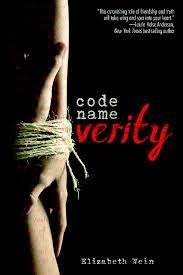
Code Name Verity
As the leaves put on a spectacular show and then drift away to slumber, as the sun heads off to its holiday home and spends less and less time in our hemisphere, I too have begun to spend more time with my feet up and a book in hand. While I love the hectic pace of summer, as fall blows and creeps in, I find I am ready for this slowdown and with it, an inward turn toward warm blankets and good books.
One of the first books I grabbed this fall was "Code Name Verity," a young adult novel by Elizabeth Wein. Having received heaps of praise in the past year, this World War II tale full of twists and turns, friendship, daring, and ultimately, tragedy, had been on my list for some time. Yet neither the recommendations or even the general awareness of the plot quite prepared me for this gripping tale.
Written in two parts, "Code Name Verity's" fist half spills forth in an epistolary format throwing us into the confession of our narrator, a female British spy captured in occupied France by the German gestapo tortured into submitting that which we read. Told in order to keep herself alive, this tale is the gripping narrative of a cunning, brash, flirty young woman's rise within the British forces leading up to her current mission. Yet it is also far more. In addition to giving us edge of your seat historical action, Queenie, our narrator and Wein our author instead, weave together an intricate tale of two great friends. For as it turns out, Queenie's tale is inexorably linked to that of her best friend Maddie's.
Maddie too is a young women on the rise in the British forces, however, Maddie is Queenie's absolute opposite. She is a commoner that plays by the rules and is loyal to the end. She is also a terrific pilot and mechanic and it is this skill that finds her in France along with Queenie, left behind in the wrecked fuselage of the plane that flew them there. And it is Maddie's point of view we receive in the second half of the book as suddenly, all we believed we knew is turned upside down.
There is of course, far more to tell about this wonderful novel but in doing so, a fantastic finish would be utterly spoiled. Instead, I will leave you with these words of encouragement to take to your blanket and the now dark night. This is a gem of a book that provides history, action, friendship, love and most importantly strong, inspiring, and beautiful characters that you will fall in love with. Be prepared, you will undoubtedly want to read "Code Name Verity" not just once but twice.
Monday, September 9, 2013
Tasting and Touring Michigan's Homegrown Food
But of course like many of you I already knew, enjoyed and indeed basked in this knowledge as well as all of the goodness grown here in Michigan. Yet when Jaye Beeler's "Tasting and Touring Michigan's Homegrown Food" arrived on our library shelf, I wondered if this read couldn't possibly help me take my localvore habits to the next level. And it has and in far more ways than I expected.
Following an introduction that lays out our authors vision of both the availability of good local food as social justice as well as the premise of a road trip that takes in and then delivers the massive edible diversity Michigan has to offer, "Tasting and Touring Michigan's Homegrown Foods" strides off into the field followed by the orchard, the water, the dairybarn, the market, and finally the kitchen. Each of these locales is given its own chapter that moves from road stop to road stop providing gorgeous photos, personal stories from both the author as well as from either the farmers, cooks, and or proprietors in addition to plentiful facts and a list of resources that includes contact, geographic, and purchasing information. Sound like a lot? It is.
Yet at no point does "Tasting and Touring" drag and neither does it attempt to be all encompassing. This is accomplished through Beeler's enthusiasm, obvious passion for good, local food, genuine interest in the stories of those that grow, harvest, produce, and market these foods, and Diane Carroll Burdick's wonderful photos. Additionally, Beeler's decision to introduce the reader to a wide range of foods stopping at only one of each type of grower, producer, or organization rather than attempt to provide an exhaustive list gives the reader a great starting point without overwhelming. This route does though occasionally leave regions of the state short changed and it does become a tad obvious that Beeler is a southwestern Michigander as her road trip frequently lands at such destinations yet despite this singular flaw, "Tasting and Touring Michigan's Homegrown Food" is a more than worthwhile read. I might even go so far as to call it mouthwatering.
Saturday, August 3, 2013
Bo at Ballard Creek
"Bo at Ballard Creek" by Kirkpatrick Hill caught my eye because, first and foremost, I heard a patron in the library describing it as a heartwarming and disarming modern version of "Little House in the Big Woods" a tale I greatly enjoyed oh-so long ago. Like "Little House," "Bo at Ballard Creek" is more a series of episodes than a straight story.
Set in a 1920's mining camp in Ballard Creek Alaska, "Bo" portrays one year in the life of our young, sweet, narrator Bo as she encounters and describes both daily life in the camp, and a string of small happenings such as the first time an airplane visits the camp, a run-in with a grizzly, and befriending an abandoned boy. And, having lived in that frontier known as Alaska for a spell as well as having studied the state's history, I can safely safe that "Bo at Ballard Creek" depicts all of this in a manner that is authentic and yet wonderfully and naively upbeat.
Yet "Bo at Ballard Creek" is not just a comforting and rose tinted throwback. Instead, Hill presents his intended audience with a highly valuable lesson about family. For Bo is an orphan being raised by two papas as she describes them. Now this isn't the modern twist you may be thinking of but is instead a true to life depiction of the historical gold mining reality. Some of those that rushed to that untamed wilderness naturally didn't have a missus and just as naturally, some of these solo adventurers made the wise decision to throw their lot in with others for all kinds of reasons. In "Bo at Ballard Creek," the given reason is safety and camaraderie. Arvid and Jack, the two papas, have formed a team to keep each other company and wisely, to keep from getting killed in that wild, untamed, not-yet state.
And it's a good thing they did because when Mean Millie, a "good time girl" dumps her unwanted baby in their arms, they will need all the help they can get to raise baby Bo as she is dubbed. Help arises of course, in the form of every single individual in the mining camp and eskimo village that the Ballard Creek mining camp lies next to. It is this depiction of that old saying "that it takes a village to raise a child" that "Bo at Ballard Creek" brings home but just like the tale itself, it does so in a manner that is both genuine and yet idealistic at the same time and it this combo, this ability to be true yet buoyant that makes "Bo at Ballard Creek" a great read for all ages.
Wednesday, July 10, 2013
The Initiates
As a literati that recently moved to an up and coming wine country, I was both very excited and just a tad nervous. You see, I am a beer drinker. A malty stout, a crisp and fruity hefeweizen, a mouth puckering IPA, these are my nomenclature. I have read about them, brewed them, and of course, drank them in large quantities. Wine though, not so much. So naturally, in the past year, I have embarked on some research.
Slowly but surely, my wife and I have been making our way around Leelanau county's plethora of vineyards and I have enjoyed nearly every experience. However, despite countless descriptions and tastings of this or that variety, something was still missing. What I needed, was a book. Then I found "The Initiates" by Etienne Davodeau. Now, "The Initiates" is not a guide to how to drink and taste wine. Far from it in fact. Instead, Davodeau's marvelous work is a graphic novel both depicting and describing a cross initiation of sorts. More precisely, Davodeau, who is an award winning graphic novelist that lives in the Loire Valley of France home to the Coteaux du Layon vineyards, spent one year making organic, biodynamic wine with his vintner neighbor. In return, this neighbor, Richard, spent a year learning how to produce a graphic novel. While this doesn't sound like the education in wine I was craving, trust me, it is that and more.
With 265 pages of muted but breath-taking black and white illustrations and dialogue, Davodeau manages to not only thoroughly depict much of the process of making small batches of wine, but he also provides a look into the process of graphic novel creation and publication and the cultures and communities both exist within.
Yet where Davodeau truly shines, is his examination of craft. For both Davodeau and Richard are not only well known and respected within their trades, but both are also meticulous experts that pore their souls into what they do. It is the conveyance of exactly this depth through small moments and snatches of conversation amongst the display of both professions day-in-day-out tasks that makes "The Initiates" a spellbinding work that will capture any that takes the time to pick it up.
Wednesday, June 12, 2013
Swimming Home
It began with Arundahti Roy's novel that moved me to tears, lots of them. Her book, "The God of Small Things" was assigned to me in a class and when I, being so moved, went to my professor's office hours to commune with a kindred spirit, she casually mentioned that it had won the Man Booker literary prize and that I ought to peruse other such winners. On this advice I found my way not just to a few of the other winners, but to many of the books that had made the short list of finalist. This is a habit I have continued and rarely have I been let down.
Deborah Levy's "Swimming Home" was a 2012 Man Booker short list finalist that like many such others before it, was oh-so-satisfying. Now "Swimming Home" is not satisfying in that warm cup of tea on a cold night sort of way. Instead, it is most decidedly a cerebral shiver of secret joy for it is dark, deranged, erotic as well as strangely funny and nearly impossible to put down.
The tale takes place in a weeks time in France. Two couples that don't seem to particularly like each other have rented a villa for the summer. One couple's lives are spiraling into disaster due to the bancruptcy of their London antique gun and jewelry shop while the other couple's marriage is a facade held together by a thread. This second couple and their 14-year-old daughter are the main players in the story. They anyways, and the mentally unstable, naked nymph they all find floating in the pool when they arrive. Strangely, Isabel the wife, who is a famous television war correspondent, invites Kitty Finch the nymph, to stay. This invitation serves as the mechanism that turns the wheels of Levy's book as Kitty is in fact a mentally ill stalker of Isabel's husband Joe, or J.H.J, or Jozef, a famous philandering poet with deep troubles of his own.
All of the characters and indeed the whole of the story Levy creates is pulled together bit by bit in brief snatches of scenes that are at once rich and lean, expressive of the whole while never quite giving it to us until the end when she triumphantly and beautifully shocks us. Levy is a surgically precise master packing her sentences with layer upon layer of meaning yet also manipulating us through nuance and language. This skill, along with a story that shrewdly twists a standard plot makes "Swimming Home" a true treat.
Monday, May 20, 2013
A Monster Calls
Crafted out of an idea young adult author Siobhan Dowd was not able to bring to fruition before her death, A Monster Calls by Patrick Ness introduces us to numerous monsters as well as to Conor, the boy they both plague and may ultimately save. One of the beasts Conor faces is amorphous and duplicitous. It is his mothers cancer and it has turned Conor’s life into a shell of what it once was making him the target of both bullying and pitied ostracism at school as well as an adult in responsibility while still a child mentally. Yet it is also the cancer that brings the other monster calling. The literal monster.
A Monster Calls is a supernatural thriller, folktale, and despairingly realistic tragedy woven together. Although this combination sounds both ominous and out-there, it is precisely the marvelous pairing of these disparate elements that counters the difficult and depressing realism that a losing battle with cancer presents. It is also this unique combination that allows Ness to portray the emotional, mental, and physical complexities that a 13 year old in such a difficult situation must face.
Told with a proliferation of staccato sentences and paired nearly page by page with deeply malefic and almost abstract black and white illustrations by Jim Kay, A Monster Calls importantly though, does not provide easy answers. Instead, Ness asks Conor and the reader to interpret truth, to pick from the better of multiple evils, and to realize that life is not simple. It is this crucial lesson that in the end not only helps Conor but will leave all readers and especially teens with a broader, more realistic look at the hard decisions and situations that life sometimes places before us.
Thursday, May 2, 2013
The Dark
We all have unique fears. After not one, not two, but three separate incidents in which I cracked pistachio shells and then threw large bugs rather than nuts in my mouth, I now have a lingering fear of pistachios in the shell. This doesn't stop me from eating the tasty buggers mind you, but now I crack, cautiously examine, then gobble. Despite this and a handful of other quirky phobias, the fears that occupy the more prominent spots in my consciousness are those that I share with so many others. Indeed, it almost seems as if some fears are universal. And the dark is one of them.
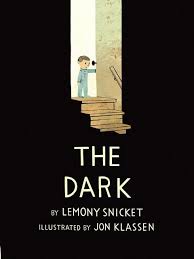
Thus it was part morbid curiosity and part excitement that lead me to Lemony Snicket and Jon Klassen's picture book The Dark. The excitement stemmed from the fact that two great talents had come together to craft one book. The morbid curiosity, well, that came from my fear of the dark, a fear shared not just with many of you, but also with our main character, Laszlo.
Seen throughout the tale in a simple pair of blue footy pajamas, the somewhat austere Laszlo lives in a big house with "a creaky roof, smooth, cold windows, and several sets of stairs." Yet, he doesn't live there alone. Perfectly personified, Snicket has given portions of Laszlo's house over to the living, breathing, and talking dark. Sometimes the dark hangs out in the closet, sometimes behind the shower curtain, but mostly, it is found in the basement in a "distant corner...pressed up against some old, damp boxes, and a chest of drawers that nobody ever opened." That is until half way through the tale when the dark visits Laszlo in his room and calls him to the basement.
I won't give away the ending but I also won't leave you... in the dark. Instead, I will simply state that despite some wonderfully built tension and anxiety, Laszlo manages to conquer his fear in a manner that will help any young reader feel a bit more snug not just in the dark but also in a creaky house or strange closet.
This ending is a fitting culmination of the just-right, simple, and satisfying narration. However, it is not just the perfectly paced tale that makes this book a great read but rather, it is the pairing of this story with Klassen's clean illustrations that elevate it to a worthwhile read for those old as well as young. Klassen's spreads contrast abundant dark space with a minimal color pallete and simple lines that truly make the dark come alive and grow and in the end, recede. Together, this artwork and Snicket's story meld into a beautiful book that deserves a prominent and bright spot on any shelf.
Tuesday, April 9, 2013
The Hungry Ear: Poems of Food and Drink
I am not an ardent lover of poetry. In fact, by and large I find it all too easy to simply forget about this, as Wordsworth described it, spontaneous overflow of powerful feelings. Yet, every year as the snow melts and the plants, animals, and even humans that have slipped into dormancy begin to arise and sing, so too does my soul and that is when I find myself searching out this expressive genre. Perhaps that is why every spring I so look forward to the month of April designated as National Poetry month.
However, likely due to my status as an infrequent reader, without fail I find myself struggling year after year to know where to turn. And that is why this April, I was utterly elated to discover "The Hungry Ear" a collection of poems focused on, related to, and in praise of food and drink edited by Kevin Young.
I first picked up this collection simply because I was intrigued. Food and poetry? Where do these two seemingly disparate things meet I wondered? My intrigue was quickly quenched as even from a brief first reading, it is apparent that food and poetry not only meet again and again but are indeed, seemingly made for each other. As Young states in his introduction to the collection "food and poetry each insist that we put our own twists and ingredients in the mix: we make each dish, like a good poem, our own. With any luck, the result is both surprising and satisfying, exactly what we wanted, perhaps without even knowing it."
And this collection is most definitely surprising and satisfying. Organized first seasonally and then further broken down by activities that occur within each season, wonderful selections such as Ruth Stone's "Pokeberries" and Billy Collins "Osso Bucco" are found underneath categories like First Harvet and Meat and Potatoes. Those though, are just two of the many categories and poems and there are certainly oh-so-many more. To be sure, this thick collection, like a good meal, presents a vast array of tastes to be savored bit by bit. Fortunately for me, April is just getting started and who knows, perhaps this year my poetry diet will last just like the "Hungry Ear."
Monday, March 25, 2013
In Zanesville
Like everyone else, I enjoy books full of action, books portraying astounding characters, books that take me to a foreign place, books that fill me with suspense, and books that put me in situations I will never actually find myself in. However, the books that frequently strike me most deeply do none of these things. Instead, many of the tales that stick to my ribs and leave me full long after I have finished them, portray life as it is lived by the most of us; a process of experiencing, navigating, and learning from both small horrors and more importantly, small wonders. "In Zanesville", a 1970s coming-of-age tale by Jo Ann Beard is precisely one of those books.
A 2012 Alex Award winner, an award given to books that appeal strongly to both teens and adults, "In Zanesville" is indeed so much about the average life, that the main character is never given a name. She could be me, or she could be you. But who she really is, is a watcher and a follower making it through her 14th year of life, the ninth grade, an alcoholic father, and a mother on the edge of meltdown by doing what many of us did during our teenage years. She hangs out with her best friend known as Flea, she babysits, she spys on the neighbors and at the center of this novel, she experiences life's constant but humble wonders and horrors.
These wonders and horrors include discovering boys as well as how wrong one can be; suddenly realizing that marching band is for dorks and quitting right at the start of a parade; getting noticed by the popular crowd and nearly losing one's best friend because of it; and being overjoyed to see your father because his depressive drinking made you worry about suicide.
Yet perhaps the greatest wonder of all, is Beard's ability to make every character full, utterly believable, and true. This is accomplished by a pitch perfect tone, a dry sense of humor, and by the author spending time developing every character readers come in contact with. It is a remarkable feat and it is this as well as Beard's celebration of life as most of us know it, that sets "In Zanesville" apart.
Thursday, March 7, 2013
Dust to Dust
Call it a twist of fate or more likely, call it simple coincidence, but not half way through my last read, Bruce Catton's history of Michigan, our state Library released the 2013 List of Notable Michigan Books. This annual list presents a fantastic mix of adult and children's fiction and nonfiction written by Michigan authors or set in our wonderful state. And in yet another... twist of coincidence we'll call it, it just so happened that one of the listed books that most intrigued me, Benjamin Busch's "Dust to Dust," was currently displayed on our new nonfiction shelf. So I grabbed it. Then devoured it.
And indeed, "Dust to Dust" is a book for devouring, digesting, and breaking down to its elements. For that is precisely what Busch does. His memoir does not simply present the recollections of a life lived according to the strictures of time but instead, bends and blurs a life of memories around a series of elements of his own - arms, metal, water, soil, bone, stone, blood, and ash. Busch uses these constituent particles to tie together his memories but also to get at the core of life and more specifically, the impermanence of life.
For instance, in discussing his childhood in upstate New York, a location and temporal period that a large portion of the book is focused on, he details at one point, his attempt to overpower nature and a river by building a stone damn across it only to eventually watch his days work wash away.
Impermanence, power, and of course nearly all of his elements including dust, blood, and ash are key players in what is another central role in Busch's life and book, that of a Marine serving two tours in Iraq. Much like Busch's childhood that was spent alone digging and building forts in the woods, his adult Marine life finds him doing the same as the ideal soldier yet still isolated and now, wondering what it is all about.
Finally, after his tours and then years spent reprising his combatant role as an actor on shows such as the Wire, Busch brings his family to Michigan and it is here we come to both Busch's final waypoint and our reason for its inclusion on the Michigan Notable Book List. As a current resident of the state, Busch ends his book spending his time cleaning up the detritus from an old farm in the heart of lower Michigan as well as cleaning out the same from his now dead parent's home.
If all of this sounds a tad depressing, it is. Busch's book is truly a pensive rumination on a life slowly returning to its very make-up. But, like many great warrior poets before, Busch spins a story that is as much elegy as memoir and it is this poetic elevation of the basics and decay of life that is "Dust to Dust's" greatest strength.
Thursday, February 21, 2013
Michigan: A History
Specifically I was looking for a history that did not get bogged down in dates and details, an overview if you will and as a lover of literature, I wanted it to read like a story as well. Within a mere ten seconds of my query, I had the late Bruce Catton's "Michigan: A History" in my hand. Now I was a trifle skeptical at first as the book is a mere 196 pages and has an awful photo on the cover to boot but, knowing that it was penned by a fellow Petsokey-ite who had also happened to win the Pulitzer Prize, I cracked the cover anyways. And I was instantly hooked.
Just as I had hoped for, "Michigan: A History" does not dawdle too greatly on the details but instead traces the state's overarching themes and it does so in style. Catton is both a romantic and a great writer and these traits lead to a history that reads a bit like a ballet that utilizes one specific melody to tie together diverse movements. By this I mean that Catton, rather than simply describing the inhabitants and industry of each of the state's periods instead, posits the notion that the history of our state, and indeed our nation is based on a cycle of wholesale exploitation of apparently boundless resources, the inevitable let down when the resource of the time dries up, and the ingenuity that springs forth.
It is with this refrain that Catton is able to tie together the fur trade, logging, mining, the railroads, and the auto industry as well as all of the other economic, social, political, and environmental twists and turns of our beloved home. It is the cycle of boom and bust Catton claims, that ties us together as people and ties us to this state.
Altogether it is a fantastic and sometimes fanciful take on this wonderful place and it is for that very reason, that this was the perfect history for me.
Subscribe to:
Posts (Atom)